The words “full moon” in many languages
It is said that there are more than 6,000 languages worldwide (this is hard to imagine) and it is a fascinating concept to think, there are probably as many words for “full moon”.
Columns: Worth knowing
Here we begin our little journey to the full moon. A few words about the fascinating quest of the greater purpose, that includes the full moon circulating through our lives. In layman’s terms and not always scientific (astronomy experts – don’t look too closely!). We would like to wish you illuminating moments. Enjoy!
It is said that there are more than 6,000 languages worldwide (this is hard to imagine) and it is a fascinating concept to think, there are probably as many words for “full moon”.
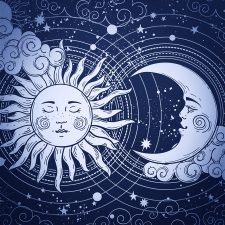
A full moon is when the Sun and the Moon are facing opposite, being in opposite direction from an Earth perspective.
This might feel astonishing if one imagines that the Moon is on one side, the Sun on the other and the Earth in between? Shouldn’t the Earth throw a shadow onto the Moon? Bingo – this is exactly what she does! But only when the Moon is exactly on the Earth orbit, the so called “ecliptic”. When this takes place, we speak of a lunar eclipse!
The Moon needs 27.33 days to circle around the Earth. Something that is also referred to as “sidereal time”. But because the Earth orbits the Sun, just like the Moon orbits the Earth, the Moon has to travel two further days in order to resume the same position to the Earth and Sun. This is then called the “sidereal time”. In order to determine the point of time of the reoccurring full moon, the sidereal time serves as basis.
We already know now that the moon month is mostly shorter than the calendar month, being on average approximately 29.5 days. If full moon falls on the first or second of a month, it is possible that another full moon occurs in the same month, for instance in July 2004:
Friday, 2 July 2004, 01:08:54 pm
Saturday, 31 July 2004, 08:05:06 pm
This event is also known as “blue moon”.
The answer is: “everywhere at the same time”. This refers to the so called Universal Time (UT) though, which is used for general astronomical events. We have already learnt that full moon is an astronomical event, where the moon, sun and the earth play a role by being in a specific position. So, full moon takes place at a specific time in the outer space. This point of time is specified by astronomers namely by the Universal Time.
There are multiple ways of approaching this question. If we look at it from a purely theoretical standpoint, we might be tempted to say that the full moon is infinitely short, since the phases of the moon are changing continuously. The moon is not yet quite full shortly before the full moon, and is already waning shortly afterwards.
However, there is a practical aspect that lets us quantify the full moon as a finite and measurable span of time: Since the Sun is significantly bigger than the Moon, its rays are able to reach just a little over half of the Moon’s surface. This means that the timespan in which the visible side of the Moon’s surface is irradiated (as seen from Earth) is longer than infinitely short.
Whether scientists, astrologers or esoterics, they agree on one thing: the moon influences earth and life on earth. For instance, it regulates the tides through its magnetism. Also continents feel the consequence of this magnetism and either raise or lower their position sometimes up to 26 cm.
In nature it is a known fact: for some animal species, mating takes place at full moon. However, the examples that can be found on this subject are rather simple. Full moon serves in some cases indirectly as the cause (for instance through the high water levels during the tides that the horseshoe crab uses to deposit its eggs) or also as the signal for both sexes of a species to begin at the exact same time to safeguard their future existence (a particular type of fly or also corals). It is understood that also wolves are led by full moon when it is time to mate.
… that people are looking for an argument at full moon or are especially happy …
… that if full moon is surrounded by a haze, a person dies …
… that you raise your hat three times to the moon (being a man) or you make a curtsey (being a woman), in order to protect yourself from misfortune until the next full moon …
… that whoever does not chink glasses with full moon at least once, does not deserve any happiness [Greek toast] …
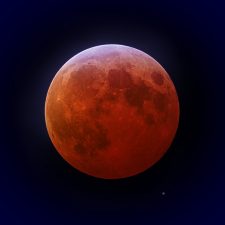
During a lunar eclipse, the Moon moves through the shadow of the Earth. Which means, that the Earth is positioned quite exactly between the Sun and Moon and casts its shadow onto the Moon. This is only possible at full moon and if some other requirements are met. Depending on whether the moon passes the partial or the core shadow of the Earth, we speak of a partial or total lunar eclipse.

Sir Charles Spencer Chaplin (1889–1977) is considered one of the first movie stars ever and made film history with his acting and his works. He is also one of the few artists who managed the transition from silent films to sound films.
Because of using archetypal imagery and symbols in his films, it is natural that the moon could also play a part somewhere. We found four references:
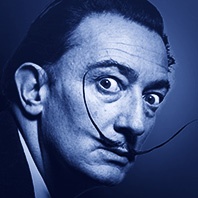
The Spanish artist Salvador Dalí (1904–1989) was the most important advocate of surrealism in paintings. His pictures show fantastic and dreamlike scenes, which remain in your memory due to their expression and originality. We also asked ourselves, whether we would be able to discover the Moon in Dalí as well, just like in other paintings (e.g. by Marc Chagal, Paul Klee, Caspar David Friedrich, William Turner, Adam Elsheimer or Petrus van Schendel)? And after a little bit of searching, we managed to find something.

A lot is said about how full moon can or could influence the sleep of people. And like so often, opinions differ on this subject. Some are certain that they sleep poorly or have a restless sleep around the time of full moon and are not able to fall asleep for a long time. Others sleep like a log … in between there are many who are not aware of any of this and not able to determine by their sleep patterns whether it is full moon or not.

Suitable for today’s 4th July, »Independence Day« in the US, and moreover it being the new moon, we pose the question of the dependency or independency of the Moon. Are we dependent on the Moon or not? And is the Moon dependent on us?
If we believe the surveys, more than 40% of people feel influenced by the Moon, in particular during sleep. In other ways as well and the influence of the Earth’s moon is being discussed in many areas, although there is still no evidence. Science rather confirms the opposite and verifies this by referring to various studies that the human is independent of the Moon; however, this does not correspond with the basic feelings of most.

We all grew up with stamps. Those small, delicate images which tell stories of countries and events and which can decorate an envelope quite wonderfully. Nowadays, letters are increasingly stamped with bar codes or rolling stamps. Still, the stamps are surviving and occasionally, the moon is to be seen on them. Mostly when a historic space travel event is being celebrated.
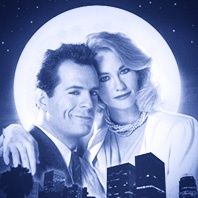
It’s been a few years ago, since we watched the TV series »Moonlighting« and could accompany Bruce Willis in the role of detective David Addison and Cybill Shepherd as the former top model Maddie Hayes, on a weekly chase of hoodlums. This was 1985, Bruce Willis’s start of his career, who had been chosen out of 1,000 applicants, and had already then an incomparably smug smile (and significantly more hair). The success of this series lies, next to the quick-witted dialogues, of course in the latent erotic relationship of the leading roles, who ingeniously never quite get it together.
In 2020 the full moon will fall on a 31st October and a Halloween party can take place in the full moon light. The imagination of people fits this well apparently, because no matter where you look, the full moon can be seen in all portrayals of Halloween. In historical terms, there is no connection, however. Halloween is the evening before All Saints’ Day (originally: »All Hallows’ Eve«). The basic idea of this festival is the remembrance of saints and it is connected to the wish to drive out bad spirits. This is how the gruesome costumes came into play.
In view of the two original principles »feminine« and »masculine«, it is tempting to attribute the feminine, receiving principle to the moon and the masculine, creative principle to the sun. And most languages, where nouns posess articles, do reflect this, like for example the Romance languages (French, Spanish, Portuguese, Italian). However, there are a number of languages, for example German, Norwegian, Polish, Slovenian, Serbian or Czech, where the moon is masculine.
So, does the moon contain more masculine quality, after all, than originally assumed?
Quite a lot! The date of Easter is actually determined by the full moon. Quite contrary to Christmas, the Easter date is part of the changing holidays and defined as follows: “Easter is on the Sunday after the first full moon in spring.”
At first glance, this appears to be quite easy: one look at the calendar, beginning of spring is currently on 20th March (though historically or in the future it may also fall on 19th or 21st March) and then simply search for the next full moon and the weekend after will be Easter.
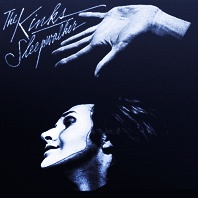
In 1977 the English music group The Kinks, released their album »Sleepwalker«, with which they returned to the more rocky sounds of the 60s after a more conceptual and overtexted phase, and thus were at least able to resume their previous success.
The Kinks are considered to be one of the most important British rock bands of this time, next to The Beatles, Rolling Stones and The Who.

A moon bridge is a pedestrian bridge, of which the semicircular arch completes a full circle through its reflection in the water and reminds of the full moon. In the old days, the high arch especially, served the purpose for barges to comfortably pass through underneath. Moon bridges originate in the Asian culture and were often built in Japanese and Chinese gardens. The mostly used materials were wood, stone and metal.